
St. Nicholas Cathedral
Олег Скуб’як, Чикаго, «Сурма»
Марія Кокор, Чикаго, «Сурма»
 Зародження парафії св. Миколая, а також розширення Українського села в Чикаго почалося у 1890-ті роки з невеликої групи відважних українських іммігрантів із Заходу України. Історичні події кінця 19 століття спонукали багатьох європейців емігрувати зі своїх рідних країн до Америки – країни можливостей. Серед них були й українські іммігранти, які спочатку оселилися в Нью-Йорку та Пенсільванії, а потім — в індустріальних містах Середнього Заходу. Нових іммігрантів до Чикаго приваблювала можливість працевлаштування у галузі скотарства та сталеливарна промисловість.
ПЕРША ХВИЛЯ ІММІГРАЦІЇ
У 1902-1905 роках значне число українців оселилося в районі Чикаго-авеню та Нобл-стріт. Серед них був молодий чоловік на ім’я Яків Оленець, родина якого була відомою в громаді своєю щедрістю. Вони заснували аптеку «Оленець» (на розі вулиць Левітт і Чикаго) та «Похоронне бюро братів Оленців», де зараз розташований Осередок свв. Володимира і Ольги. Хоча Яків був вінчаний у місцевій римо-католицькій церкві, коли прийшов час хрестити його сина Михайла, він хотів, щоб це було зроблено за українським обрядом. Він запросив священника Віктора Ковалецького, який був парохом невеликої русинської* церкви на півдні Чикаго. Священик радо здійснив обряд хрещення, а під час наступної зустрічі уважно вислухав дискусію гостей щодо бажання заснувати руську (українську) церкву на півночі Чикаго. Було організовано комісію, щоб розглянути можливість придбання будівлі для нової парафії. Комітет очолив отець Ковалецький. До складу Комітету увійшли Іван Ціхонь, Петро Винярський та доктор Володимир Сіменович.
У 1906 році перші парафіяни придбали данську лютеранську церкву на перехресті вул. Біккердайк і Суперіор, яка сьогодні є просто вул. Суперіор на схід від Ешленд авеню. Церква була заснована як русинська католицька парафія св. о. Миколая Чудотворця. Ціна купівлі склала 8000 доларів. У 1907 році священник Микола Струтинський став постійним новим парохом і залишався там до 1921 року. Під його пасторським керівництвом парафія швидко зростала і процвітала.
З новими хвилями іммігрантів з України, нещодавно куплена дерев’яна церква не могла вміщувати всіх парафіян. У 1912 році була створена комісія щодо пошуку землі для будівництва нової церкви та громадського центру. Таку ділянку землі було знайдено на Райс-стріт, між вулицями Левітт і Оклі, де зараз розташована катедра. Спочатку парафіяни скептично поставилися до місця розташування, тому що здебільшого вони мешкали біля Чикаго авеню та Холстед стріт, а трамвай їздив лише до Ешленд. Далі за Дамен-авеню був пустир.

Один із членів комітету, доктор Сіменович, закликав парафіян «рухатися на Захід». «Ми можемо збудувати нову чудову церкву; усі ми можемо купити ділянки біля церкви і зрештою збудувати свої домівки на цих ділянках і з Божою допомогою матимемо свою власну, «нову Русь» просто тут, у Чикаго». Це було перше заявлене бачення українського села в Чикаго!
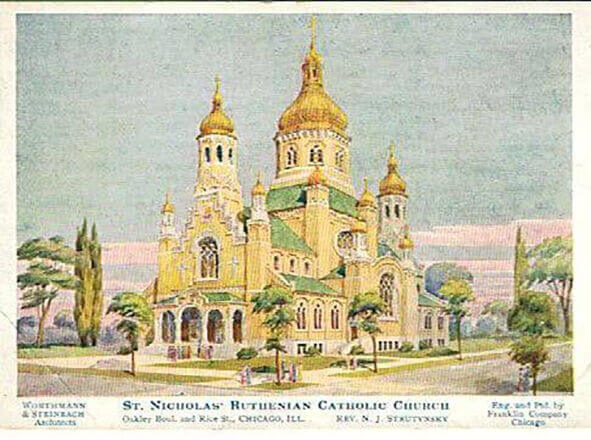
Парох і комітет перемогли, і земельну ділянку було придбано за 12 000 доларів. Для проєктування церкви в неовізантійському/бароковому стилі громада найняла Джона Г. Стайнбаха, відомого в Чикаго церковного архітектора. Церкву було спроєктовано на зразок св. Софії Київської, побудованої в 1037 році. Будівництво катедри розпочалося навесні 1913 року. Проєктна вартість будівництва склала 150 000 доларів США. Єпископ Сотер Ортинський освятив наріжний камінь у листопаді 1913 року, а на Різдво Христове, 07 січня 1915 року, на знак подяки була відслужена перша Літургія в новій церкві св. о. Миколая. Уже через тринадцять років внутрішнє оздоблення будівлі почали розписувати та прикрашати у візантійському стилі.
 Парафія стала остаточно українською в етнонаціональному сенсі. Розквітала Українська народна школа (Рідна школа). До 1922 року вона налічувала 300 учнів, які навчалися неповний навчальний день. У 1925 році прибули сестри Чину Святого Василія Великого, які взяли на себе викладацьку роботу в Школі. Парафія заснувала ощадно-позикову установу «Дніпро», яка в 1921 році налічувала 213 тис. вкладників. Землю для цвинтаря придбали на околиці міста. Був організований хор імені Лисенка, який згодом здобув популярність, коли посів перше місце на міжнародному хоровому конкурсі, спонсором якого стала газета «Чикаго Триб’юн». Молодіжна організація «Січ» об’єднала енергійну українську молодь.
Приблизно в цей час управління парафією Св. о. Миколая було доручено Чину Св. Василія Великого й розпочалася доба отців Василіян. За роки свого служіння вони були вправними розпорядниками церковного майна та відданими пастирями своєї пастви, несучи духовний провід і розраду парафіянам.
Для ефективного виховання молодого покоління української молоді та сприяння ознайомленню з українською спадщиною, обрядами, культурою та традиціями в 1935 році було побудовано школу (тепер відому як «Стара школа»), у якій учні здобували початкову освіту.
Парафія продовжувала зростати попри важкі для всіх часи Великої депресії 1930-х років. У 1932 році парафія св. Миколая налічувала 2200 парафіян.
ДРУГА ХВИЛЯ ІММІГРАЦІЇ
Після Другої світової війни до Чикаго прибули тисячі українських іммігрантів. Катедра св. Миколая, що стоїть у серці українського села, стала центром життя громади. Засновувалися нові релігійні організації; серед найактивніших були Об’єднання Пресвятої Діви Марії, Апостольство Молитви, Товариство Святого Духа та Хор «Славута». Для кращого спілкування з усіма парафіянами в 1949 році розпочалася трансляція радіопередачі.
Щоб задовольнити потреби щораз більшої кількості нових сімей, на початку 1950-х років було побудовано нову, більшу школу. На початку 1960-х років у школі навчалося 1100 учнів. На місцевому рівні було створено кілька важливих молодіжних організацій, які допомагали молодим іммігрантам зберегти зв’язок з українською спадщиною, мовою та культурою.
ЗАСНУВАННЯ ЄПАРХІЇ
У 1961 році Святий Престол заснував український єпископський осідок у Чикаго, а монсеньйор Ярослав Габро, рідний син парафії св. Муколая, став першим єпископом новоствореної єпархії. Церкві св. Миколая був наданий статус Катедри св. Миколая.
Протягом своєї історії катедра була осідком 5 єпископів: єпископа Ярослава Габро (1962-1980), єпископа Інокентія Лотоцького (1980-1993), єпископа Михайла Вівчара (1993-2000), єпископа Річарда Семінака (2003-2016) та єпископа Венедикта Алексійчука (2017 р. — дотепер). Сьогодні єпархія здійснює нагляд за всіма українськими католицькими парафіями Середнього Заходу та західної частини Сполучених Штатів і складається із 43 парафій, 3 монастирів та 7 місійних парафій.
У 1963 році рішення єпископа перейти на григоріанський церковний календар спричинило серйозний розкол у парафії. Він призвів до того, що великий відсоток парафіян, які відчули, що їхня спадщина та українська ідентичність зазнали утисків, створили нову парафію свв. Володимира та Ольги.
У 1968 та 1973 роках вірні Чикаго отримали благословення та натхнення під час візитів Блаженнішого Кардинала Йосипа Сліпого. На честь його першого візиту в Оркестра Холл відбувся концерт. Його Блаженство відслужив Божественну Літургію в Грант Парк для тисяч вірних єпархії св. Миколая.
У 1980-х роках у Соборі відбулося багато великих урочистостей, зокрема призначення нового єпископа Інокентія Лотоцького, ЧСВВ, святкування року Діви Марії, 75-річчя Парафії, Срібний Ювілей Собору та святкування Тисячоліття Хрещення України.
НОВІ ХВИЛІ ІММІГРАЦІЇ
Із розпадом Радянського Союзу в 1991 році та в наступні роки великі хвилі нових іммігрантів з України оживили українські католицькі парафії в Чикаго та передмістях, але не катедру св. Миколая. Першопричиною було те, географічно та економічно привабливим для багатьох парафіян були передмістя, і чимала кількість іммігрантів із цих причин переїхала до інших парафій. Водночас іммігранти, які прибули в США після Другої світової війни почали старіти й відходити, тому катедральна парафія значно скоротилася в кількості.
100-РІЧЧЯ
Попри те, що катедра неодноразово визнавалася пресою однією з найкрасивіших будівель Чикаго, після більше ніж ста років невпинного служіння, будівля церкви зазнала значних структурних руйнувань конструктивних елементів. Щоб вирішити ці проблеми й допомогти зберегти структурну цілісність катедри та її релігійне й історичне значення, у 2004 році було розпочато кампанію зі збору коштів до 100-річчя заснування парафії св. Миколая. У результаті проведення кампанії було зібрано майже 1 мільйон доларів, що дозволило відновити частину структури катедри, сходи, доріжки та впорядкувати територію. Урочистості з нагоди 100-річчя завершилися Архієрейською Літургією з великою кількістю відвідувачів та урочистим святкуванням на Нейві Пірс, яке відвідало 1000 людей. Гостями-доповідачами були губернатор Іллінойсу, мер Річард М. Дейлі та кардинал, архієпископ Любомир Гузар.
 НОВЕ ДУХОВЕНСТВО ТА АДМІНІСТРАЦІЯ
З призначенням нового керівництва та духовенства, у 2017 році катедра знову почала зростати й зараз переживає своє духовне відродження. Владика Венедикт, отець-адміністратор Сергій Ковальчук, а також її натхненне та невтомне духовенство відродили катедральні програми і зосередились на задоволенні духовних потреб парафіян. У 2018 році було відновлено план пастирського служіння, щоб запровадити ширший спектр літургійних богослужінь, включно з чуваннями, вечірньою та ранковою службами, які стають щораз популярнішими серед парафіян. Загалом пожвавилося життя багатьох парафіяльних організацій. Серед них — «Марійська Дружина», «Матері в молитві», «Українська молодь Христові» та «Спільнота Святого Духа». Ці організації багато в чому допомагають катедральній спільноті. Вони роблять усе, що потрібно, включно з приготуванням і продажем їжі після недільних літургій, для збору коштів на різні потреби парафіяльної спільноти. Інші заходи для парафіян та членів громади включають релігійні заняття для дорослих та дітей, християнські фільми, дискусійний книжковий клуб, настільні ігри тощо. Дуже популярною є нова щорічна програма для дітей «Канікули з Богом» (однотижневий літній табір). Перебуваючи в таборі, діти можуть поглибити свій зв’язок із Богом, навчитися цінувати Божі подарунки, шанувати нашу східну католицьку традицію і, останнє, але не менш важливе, можуть розважатися.
Катедра — це також місце для проведення багатьох місцевих заходів, концертів, публічних і освітніх лекцій, і збору коштів. У січні в соборі проводиться щорічний фестиваль колядок «Колядуймо разом» та щорічний осінній базар у листопаді.
Нещодавно почала відроджуватися і восьмирічна катедральна школа св. Миколая. Кількість учнів у школі повільно, але стабільно зростає, а її випускники опиняються в найкращих старших школах Чикаго. З початку війни школа активно допомагає новоприбулим сім’ям з України та особливо їхнім дітям, забезпечуючи їм якісну освіту.
Сьогодні, як і 80 років тому після Другої світової війни, катедра та її громада стали прихистком та джерелом спокою для біженців, що рятуються від російської агресії. Окрім того, завдяки благодійним заходам і кампаніям зі збору коштів, катедра збирає гроші на підтримку гуманітарних потреб в Україні, а також допомагає забезпечувати гуманітарні та духовні потреби новоприбулих біженців, які шукають миру та стабільності в новій країні.
 ПЕРСПЕКТИВИ НА МАЙБУТНЄ
Сьогодні катедра св. Миколая є у розпалі великого капітального ремонту, розпочатого в травні 2019 року, мета якого — усунути серйозні структурні проблеми в даху та куполах катедри, а отже, забезпечити стабільне майбутнє її структурних елементів для майбутнього її парафіян та наступних поколінь.
Незважаючи на те, що реставрація вже розпочалася і зібрано майже 3,6 мільйона доларів, попереду ще багато роботи. Ми вважаємо, що для завершення реставрації потрібно ще 2,6 мільйона додаткових коштів.
Упродовж своєї історії служіння та прослава Бога, а також пошук духовного оновлення в українському обряді є і буде постійною та важливою об’єднувальною основою для катедри св. Миколая.
Хочемо особливо подякувати п. Ірині Артюшенко, нарис якої «Святкування 100-річчя: Український
католицький собор Св. Миколая» (2006) став основою для цієї статті.
The origin of St. Nicholas Cathedral Parish, and by extension the Ukrainian Village of Chicago, begins with a small group of intrepid Ukrainian immigrants from Western Ukraine dating back to the late 1890s. The historic events of the late 19th century spurred many Europeans to emigrate from their native countries to America - the land of opportunity. Among them were Ukrainian immigrants, who first settled in New York and Pennsylvania and then moved farther to the industrialized cities of the Midwest. The job opportunities afforded by the stockyards and the steel industry attracted these new immigrants to Chicago.
THE FIRST WAVE OF IMMIGRATION
Between 1902-1905 a number of Ukrainians settled in the area around Chicago Avenue and Noble Street. Among them was a young man, Jakiw Olenec, whose family was prominent and generous in the community. The family founded and operated both the Olenec Pharmacy (on Leavitt and Chicago) and the Olenec Brothers Funeral Home, where the St. Volodymyr and Olha Oseredok now stands. Although Jakiw was married in the local Roman Catholic Church, when it came time to baptize his son Mychajlo, he wanted it to be done in the Ukrainian rite. He sought out Reverend Victor Kovaletsky who was the pastor of the small Ruthenian* church on Chicago’s Southside. The priest was happy to perform the baptism, and at the reception that followed, he listened attentively to the discussion of the guests regarding the desire to establish a Ruthenian Church on Chicago’s North side. A committee was organized to look into the possibility of acquiring a building for the new parish. Headed by Father Kovaletsky, the committee included Ivan Cihon, Peter Vyniarsky and Dr. Volodymyr Simenovych.
In 1906, the early parishioners purchased the Danish Lutheran Church that was located at Bickerdike and Superior Streets, which today is Superior Street just East of Ashland Ave. The church was established under the name St Nicholas the Wonderworker Ruthenian Catholic Parish. The purchase price was $8,000. In 1907, Rev. Nicholas Strutynsky, became the permanent new pastor and remained in that position until 1921. Under his pastoral leadership, the parish grew rapidly and flourished.
With an influx of new immigrants arriving from Ukraine, the parish outgrew the recently purchased little wooden church. In 1912, a committee was formed to look into the possibility of finding land to build a new church, as well as a community center. Such a parcel of land was found on Rice Street, between Leavitt and Oakley, the Cathedral’s present location. At first parishioners were skeptical about the location, because most lived near Chicago Avenue and Halsted Street, and the streetcar went only as far as Ashland Boulevard. Beyond Damen Avenue was empty prairie. One of the committee’s members, Dr. Simenovych, urged parishioners to “move West.”
“We can build a glorious new church; we can all purchase lots near the church; we can eventually build our homes on these lots and with God’s help, we can have our own, ‘new Rus’ right here in Chicago.” The first stated vision of the Ukrainian Village in Chicago!
The pastor and committee prevailed and the land was purchased for $12,000. John G. Steinbach, a noted church architect in Chicago, was hired to design the church in the Neo-Byzantine/Baroque style and it was modeled after St. Sofia in Kyiv, built in 1037. Construction began in the spring of 1913. The projected building cost was $150,000. Bishop Soter Ortynsky blessed the cornerstone in November of 1913 and on Christmas Day, January 7, 1915 the first Liturgy was celebrated in thanksgiving at the new St. Nicholas Church. It was thirteen years later that the interior of the building began to be painted and decorated in the Byzantine style.
The parish grew to become irrevocably Ukrainian in ethno-national thinking and action. The Ukrainian Heritage School (Ridna Shkola) flowered, and by 1922 had 300 students attending part-time classes. In 1925, the Sisters of St. Basil the Great arrived and assumed the teaching responsibilities at the School. The “Dnipro” a savings and loan institution was founded by the parish and by 1921 boasted 213,000 depositors. Land for a cemetery was acquired on Higgins Road on the city’s outskirts. The Lysenko choir was organized and subsequently won fame when it earned first place in a multi-state choral competition sponsored by the Chicago Tribune. A youth organization, “Sich” engaged the energies of Ukrainian youth.
Around this time the administration of St. Nicholas Parish was entrusted to the Order of St. Basil the Great and the era of the Basilian Fathers began. Throughout their years of service, they had been able stewards of church property and devoted shepherds of their flock, offering spiritual guidance and comfort to parishioners.
In order to effectively educate the growing cadre of Ukrainian youth and to facilitate learning about Ukrainian heritage, rite, culture and traditions, in 1935 an elementary school (now known as the “Old School”) was built to offer primary education.
In the early 1930’s, during the time of the Great Depression, times were hard for everyone but in the face of this, the Parish continued to grow. In 1932, St. Nicholas boasted 2,200 parishioners.
THE SECOND WAVE OF IMMIGRATION
Following World War II, thousands of Ukrainian immigrants arrived in Chicago. St. Nicholas, standing in the heart of the Ukrainian Village, became the hub for community life. New religious organizations were formed; the B.V.M Sodality, Apostleship of Prayer, Holy Name Society, and Slavuta Choir were among the most active. In order to better communicate with all the parishioners, a radio program was started in 1949.
To accommodate the needs of the burgeoning population of new families, a new larger school was built in the early 1950’s. By the early 1960’s, enrollment at the school reached 1,100 students. Several important youth organizations were locally formed to help the new immigrant youth maintain a connection to Ukrainian heritage, language and culture.
EPARCHY ESTABLISHED
In 1961, the Holy See established a Ukrainian episcopal seat in Chicago and Monsignor Jaroslaw Gabro, a native son of the parish, became the first bishop of the newly created Eparchy. St. Nicholas Church was elevated to the status of St. Nicholas Cathedral. Throughout its history the Cathedral has been a seat of 5 bishops: Bishop Jaroslaw Gabro (1962-1980), Bishop Innocent Lotocky, (1980-1993), Bishop Michael Wiwchar (1993-2000), Bishop Richard Seminack (2003-2016) and Bishop Benedict Aleksiychuk (2017 to present). The Eparchy today oversees all the Ukrainian-Catholic parishes of the Midwestern and Western United States and is comprised of 43 parishes, 3 monasteries and 7 mission-parishes.
In 1963, the Church hierarchy’s decision to establish the Gregorian church calendar caused a serious rift in the Parish. This unfortunately caused a large percentage of parishioners, who felt that their heritage and Ukrainian identity were being assailed, left to form a new parish, Sts. Volodymyr and Olha.
In 1968 and in 1973, the faithful of Chicago were blessed and inspired by the visits of His Beatitude Cardinal Joseph Slipyj. In honor of his first visit a concert was held at Orchestra Hall. His Beatitude concelebrated a Divine Liturgy in Grant Park for thousands of faithful.
In the 1980’s the Cathedral witnessed a number of major celebrations, including the installation of a new Bishop, Most Reverend Innocent Lotocky OSBM, the celebrations of the Marian Year, the Parish’s 75th Anniversary, the Silver Jubilee of the Cathedral, and the commemoration of the Millennium of Christianity.
NEW FLOWS OF IMMIGRATION
With the fall of the Soviet Union in 1991 and in the ensuing years, a continuous stream of new immigrants revived the Ukrainian Catholic parishes in Chicago and the suburbs but not necessarily St. Nicholas Cathedral. Moreover, the suburbs had geographic and economic appeal to many parishioners and a good number moved to other parishes tor these reasons. At the same time, the post-WWII immigration began to age and pass away. For this reason, the Cathedral congregation contracted considerably.
100th ANNIVERSARY
While the Cathedral has been recognized numerous times in the press as one of the most beautiful edifices in Chicago, after more than a hundred years of service and graceful aging, it began to encounter significant age-related structural issues. To begin to address these issues and to help preserve the Cathedral’s structural integrity and its religious and historical significance, a fundraising campaign was launched in 2004 to commemorate the 100th anniversary of the founding of St. Nicholas Parish. The campaign raised nearly $1 million and allowed for the rebuilding of parts of the Cathedral’s infrastructure, stairs, walkways and landscaping. The 100th Years Anniversary festivities were culminated by a well-attended Hierarchical Liturgy and a gala celebration at Navy Pier with 1,000 attendees. The guest speakers were the governor of Illinois, the mayor Richard M. Daley and Cardinal Archbishop Lubomyr Husar.
NEW SPIRITUAL AND ADMINISTRATIVE LEADERSHIP
With the installation of new leadership and the arrival of new clergy in 2017, the Cathedral is once again growing and experiencing a spiritual revival. Bishop Benedict, Administrator Fr. Serhiy Kovalchuk, and the inspiring and hard-working clergy have energized the Cathedral and its ministries, and are focused on addressing the spiritual needs of its parishioners. In 2018 a pastoral ministry plan was revived to introduce a broader range of liturgical services, including nightly vigils, vespers, and mattins that have become increasingly popular with parishioners. Overall, the life of many Parish organizations was revived. Among them are the “Marijska Druzhyna”, “Mothers in Prayer”, “Ukrainian Youth for Christ” and “Holy Spirit Community”. These organizations are actively helping the Cathedral community in many ways. They do whatever is needed, including preparing and selling food after Sunday liturgies to help raise funds, or assist priests in organizing activities and events for the community. Other activities for parishioners and community members, include religion education classes for adults and children, Christian Movies and BooksDiscussion club, board games and more. A very popular new annual program for children is “Vacation with God”, a one-week summer camp. While at the camp, children aspire to develop a deeper connection with God, learn to appreciate God’s gifts, honor our Eastern Catholic tradition and, last but not least, have fun.
The Cathedral is also a place of gathering for many local events, concerts, public lectures, educational and fundraising events. The Cathedral hosts an annual festival of carols “Caroling Together” in January and the Annual Autumn Bazaar in November.
The Cathedral School has recently experienced a similar revival. The number of students at the School is slowly but steadily growing, and its graduates are qualifying for the best high schools in Chicago. Since the beginning of the war, the School has been actively engaged with helping newly arrived families from Ukraine and especially their children to provide them with quality, free-of-charge education.
Today, like 80 years ago when the post World War II immigrants arrived, the Cathedral and the Community, have become a source of comfort and refuge for a new wave of immigrants and refugees fleeing the Russian war in Ukraine. Moreover, through charitable events and fundraising campaigns, the Cathedral has been raising funds to support humanitarian needs in Ukraine as well as the humanitarian and spiritual needs of newly arrived refugees looking for peace and stability in a new country.
LOOKING FORWARD
Today, St. Nicholas Cathedral is in the midst of a major Capital Campaign launched in May 2019, to address serious and urgent structural issues in the Cathedral’s roof and domes, and thus to secure its future for its parishioners and following generations. While the restoration is well underway and almost $3.6 million has already been raised, there is still considerable work to be done. We estimate that $2.6 million of additional funds will be needed to complete the restoration.
Throughout the history of St. Nicholas Cathedral, the mission of serving and glorifying God, and seeking spiritual renewal within the Ukrainian rite, has been a constant and the essential unifying stronghold for the Parish.
We would like to acknowledge and thank Irene Artiushenko whose essay in “Celebrating 100 Years: St. Nicholas Ukrainian Catholic Cathedral” (2006) served as a basis for this article. (Oleh John Skubiak and Mariya Kokor)
Підтримати віднову катедри св. Миколая можна:
1) чеком
2) онлайн через QR код
